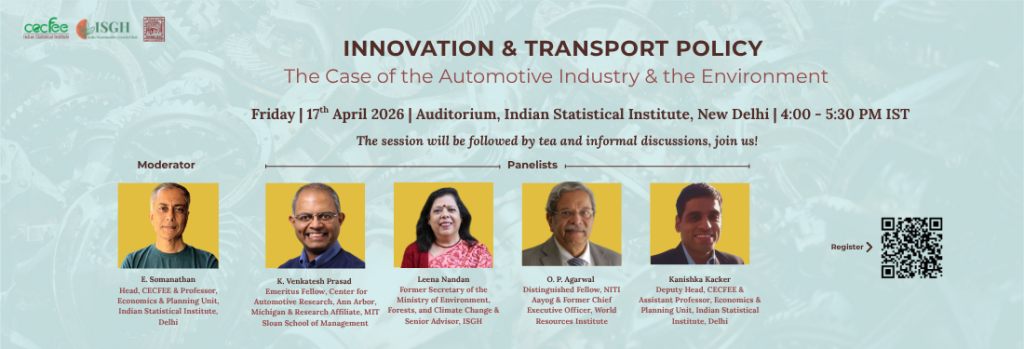
Panelists:
1. Mr. K. Venkatesh Prasad, Emeritus Fellow, Center for Automotive Research, Ann Arbor, Michigan & Research Affiliate, MIT Sloan School of Management
2. Ms. Leena Nandan, Former Secretary of the Ministry of Environment, Forests, and Climate Change & Senior Advisor, India Sustainable Growth Hub (ISGH)
3. Mr. O. P. Agarwal, Distinguished Fellow, NITI Aayog & Former Chief Executive Officer, World Resources Institute
4. Dr. Kanishka Kacker, Deputy Head, CECFEE & Assistant Professor, Economics & Planning Unit, ISI, Delhi
Moderator:
E. Somanathan, Head, CECFEE & Professor, Economics & Planning Unit, Indian Statistical Institute, Delhi
Date: Friday, 17 April 2026
Time: 4:00 – 5:30 PM IST
Venue: Auditorium, Indian Statistical Institute, New Delhi
Registration Link (latest by 15th April EOD): CLICK TO REGISTER
About the discussion:
On the grand stage of global economic growth, the tango between technological innovation and policy offers many an insight into what may be needed today to address some of the most pressing environmental issues in our midst.
The automotive industry offers a rich repository of cases-in point both in terms of where the prevailing policy lagged technological innovation and where policy led & shaped technological innovation. What makes this germane to a current discussion on economic development and the environment is the potential that some of the lessons from the past may inform ongoing policy considerations that affect both the automotive industry and the environment. Additionally, the automotive industry is a good proxy for other engines of national or regional development, given the numerous spillover innovations associated with its product creation, distribution and “end-of-life” processes.
As the production of the “horseless carriage” began to scale in the early 20th century, policy appeared to be blindsided by technology — both metaphorically and in real physical terms — there were no emissions controls or for that matter traffic signals. Policy largely lagged technological innovation. That changed, later in the century, with new policy leading technological innovation and shaping the democratization or mass market access to products with improved (reduced) tailpipe emissions, improved fuel economy, reduced “cradle-to-grave” materials, and steadily improving (occupant & roadway) safety.
The internal combustion engine (ICE) vehicle to battery electric vehicle (BEV) transition offers an exciting new opportunity to “solve” for some of the pressing problems that concern the environment — this will be the focus of this discussion.